
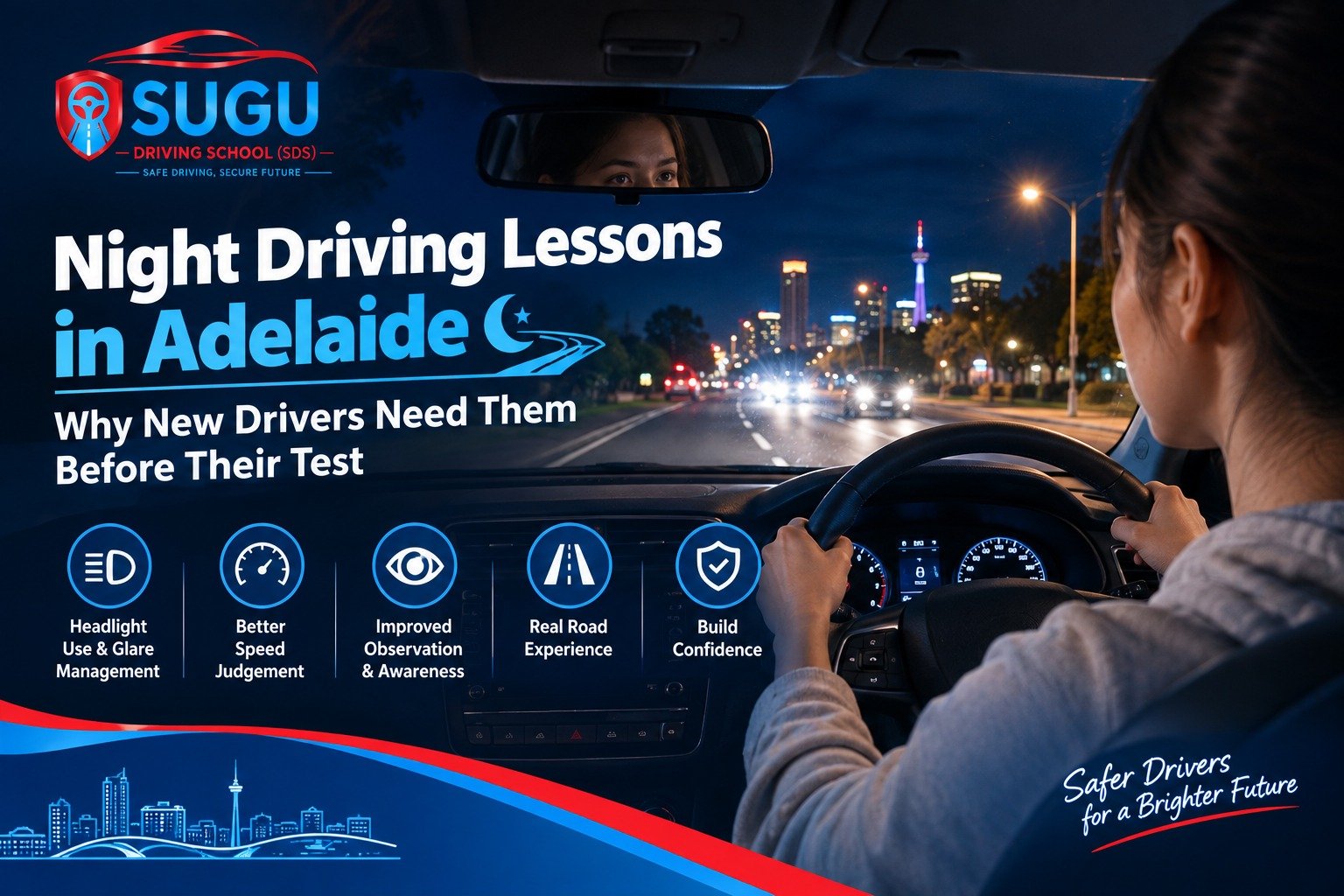
Driving after dark is not simply daytime driving with the headlights switched on. Distances are harder to judge, pedestrians and cyclists are less visible, glare can temporarily reduce your vision and familiar roads can look completely different. For a new driver, that extra workload can make night driving feel much more demanding than expected.
South Australia recognises this in the learner system. Learner drivers must complete at least 75 hours of supervised driving, including a minimum of 15 hours at night. Those hours are not there just to fill a logbook. They are designed to give learners experience with conditions they will eventually face without a supervisor beside them.
Why night driving is a separate skill
At night, your useful field of vision is shaped by street lighting, headlights and contrast. A dark clothed pedestrian can be difficult to see until you are much closer. Oncoming headlights can create glare. Reflections from wet roads can make lane lines harder to read. Your eyes also need time to adjust when moving between bright and dark areas.
Official South Australian road safety guidance notes that all drivers have a higher crash risk late at night and that the risk is particularly high for inexperienced young drivers. That is why supervised night practice should be treated as a core part of learning, not something to leave until the last week before a test.
What a good night driving lesson should teach
- Using low beam and high beam correctly and knowing when high beam must be dipped.
- Adjusting speed so you can stop within the distance you can actually see ahead.
- Managing glare from oncoming vehicles without staring into the headlights.
- Scanning more deliberately for pedestrians, cyclists and animals.
- Reading lane markings, road edges and signs in lower visibility.
- Managing busy illuminated areas where traffic lights, shop signs and headlights compete for attention.
- Recognising fatigue and understanding when you should not drive.
Headlights are part of your safety system, not just a switch
South Australian rules require headlights, rear lights and the number plate light to be on between sunset and sunrise and in poor visibility. High beam can improve the distance you can see on dark roads, but it must be used responsibly. Drivers must dip high beam when required so they do not dazzle other road users.
New drivers also need to learn a practical habit that sounds minor but matters: keep the windscreen and headlights clean. A dirty windscreen can scatter light and make glare worse, while dirty headlight lenses reduce useful illumination.
Night lessons improve speed judgement
One of the most useful things you learn after dark is that the posted speed limit is not always the speed you should drive. On an unlit road, you need enough visible distance to identify a hazard and stop safely. If your headlights only allow you to see a limited distance, your speed should reflect that.
This becomes even more important in rain or poor visibility. A professional instructor can help you understand when a speed is technically legal but still too fast for what you can see.
You learn to manage glare without panicking
Many learners instinctively look towards bright oncoming headlights. That can leave you temporarily dazzled. South Australian guidance recommends avoiding direct focus on the lights, looking towards the left side of the road and slowing down if your vision is affected. If you cannot see, stop safely rather than continuing blindly.
Practising this with an instructor builds a controlled response before you encounter the situation alone.
Night lessons can expose gaps that daytime lessons hide
A learner who feels confident during the day may discover at night that they follow vehicles too closely, notice speed signs late or struggle to judge when a pedestrian is about to cross. These are useful discoveries because they can be corrected while a qualified supervisor or instructor is present.
Professional night lessons also give you structured exposure to different roads. Sugu Driving School offers night lessons from 6:00 PM, with attention to headlight use, judging distance and speed after dark, glare from oncoming traffic and reading roads with limited lighting.
Do night lessons help before the VORT?
The VORT itself is normally conducted within approved daytime testing periods, so the point of night training is not to rehearse a night version of the test. The value is broader. Night driving forces you to improve observation, speed choice, anticipation and hazard awareness. Those are the same core skills that make your daytime driving safer and more independent.
Completing your required night hours with meaningful practice rather than simply driving an easy familiar route can therefore improve the overall quality of your driving.
How to use your 15 night hours well
- Start with familiar suburban roads so you can focus on visibility rather than navigation.
- Progress to busier roads, roundabouts and multilane traffic after you are comfortable.
- Include some roads with limited street lighting under safe supervision.
- Practise in different weather conditions when appropriate, not only on clear nights.
- Drive at different times after sunset so you experience both busy evening traffic and quieter conditions.
- Ask your supervisor to reduce prompting as your judgement improves.
- Use at least one professional night lesson to identify habits your family supervisor may not notice.
The goal is confidence without overconfidence
A good night driver is not someone who feels fearless in the dark. It is someone who recognises the limitations of visibility, adjusts speed, keeps scanning and makes conservative decisions when the road ahead is unclear. Those habits take repetition.
If you are learning to drive in Adelaide, do not treat night hours as a box to tick near the end of your logbook. Spread them through your learning period, practise varied conditions and use professional instruction where it helps. Sugu Driving School's night lessons can be used to build the specific skills that become harder after sunset, before you are expected to manage them on your own.
Book a lesson with Sugu Driving School
Door-to-door pick-up across Adelaide in a dual-control automatic, with an instructor who will tell you exactly what still needs work before your test.